https://www.instagram.com/p/BbAKjljFM_O/
Shout out to whoever left this piece of cake in my desk drawer yesterday when I was absent.
https://www.instagram.com/p/BbAKjljFM_O/
Shout out to whoever left this piece of cake in my desk drawer yesterday when I was absent.
https://www.instagram.com/p/BY4M67uFRhW/
It’s World Suicide Prevention Day and it’s okay to ask for help. It’s also okay to not compare your life to someone’s filtered, edited highlight reel. You are never alone. WHS is filled with people who care. I am here for you.
https://www.instagram.com/p/BZQ2-2SliR5/
Thank you to the kind soul who taped this emergency snack to my cabinet. #thevikelife #pod1000chat

Please remember that very few of us have it completely together.
Remember this because I know there are people out there who feel bad when they see how lovely other people’s lives appear to be.
Remember that if you are a person wondering why other people have more pristine lives than you that you are probably doing okay and if you’re not, other people will help you, if you ask.
Remember that if you want to portray a perfect life, it might actually hurt someone who is observing.
Be real, if you can.
If you see someone looking all perfect, most likely, they are just really good at filters–literal and metaphorical filters.
Correct me if I’m wrong, perfect people.

 Spencer E Holtaway via Compfight
*This was originally posted on Aug. 13, 2013. Updates were made on April 26, 2016 and February 7, 2017.
If you’re getting ready to participate in a Twitter chat for the first time, this little post may be helpful to you.
I’ll be using #nebedchat (Nebraska Education Chat) as an example because it’s a chat I’m involved in either as a moderator or more frequently, as a participant.
1. The first thing to remember is always use the chat’s hashtag in all of the tweets you send in response to the chat. In this case, the hashtag is #nebedchat. Make sure that you leave enough space in your tweet for that hashtag because it counts against your 140 character.
2. When you use a hashtag like #nebedchat, it creates a backchannel. A backchannel is just a place where ALL of the tweets that include the hashtag show up. You’ll notice a variety of tweets below. I captured this series of tweets whilst in the #nebedchat backchannel. Notice that all of the tweets include the #nebedchat hashtag.
NOTE: Click on the images in this entry to get a larger, clearer view of the screen captures I posted.

3. Make sure you are in the LIVE backchannel (This shows everything that was tweeted.), rather than the TOP TWEETS tab, which will only show you the tweets that get “favorited” a lot.
Some people use an app like TweetDeck to keep an eye on multiple hashtags, but when I am participating in a chat, here is what I do. I use Firefox, if I’m using my Macbook Air, and Safari, if I’m using my iPad, so that I can open multiple tabs simultaneously. I like to keep the backchannel for the chat AND my Twitter interactions tab open at the same time. That way I can see EVERY tweet posted in the backchannel as well as all tweets directed specifically to me.

(Any time someone posts something with my Twitter handle -@morgetron- it shows up in my interactions feed.) I toggle between these two tabs throughout the chat.
4. When you first arrive to a chat, it is usual practice to introduce yourself briefly–usually your name and occupation will do, but sometimes a moderator will ask for additional information.
In the tweet below, #nebedchat moderator, Chris (@chrisstogdill) asked everyone to introduce him/herself by tweeting his/her name, the school where he/she works or is associated with, his/her current position in said school and he briefly explained the preferred format for that night’s chat.

Many time there will be someone else designated as chat greeter too, so don’t be surprised if after you introduce yourself, someone other than the moderator welcomes you to the chat (though sometimes the moderator does double as a greeter as well). During busy chats, this practice is sometimes dropped, but #nebedchat-ters are notoriously friendly and odds are someone will pipe in with a warm welcome.
5. During a chat, the moderator typically uses a specific format which he/she generally will explain at the beginning of the chat (but not always). The most common format is this: The moderator poses a question, using the Q1, Q2, Q3 format. Like this:
Chris was the moderator and posed Question #2, by indicating Q2.

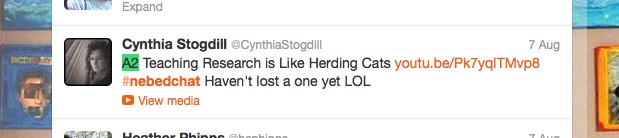
6. Then, when you answer a particular question, you use the corresponding A1, A2, A3, etc.
Cynthia (@cynthiastogdill) responded to Chris’s Q2 by indicating A2 (Answer 2).
I like Lenessa’s (@lenessakeehn) explanation for this practice as well:

6. During a chat you can respond to the questions posed by the moderator OR you can respond to what other people are saying. For example, you will notice that Laura (@mandery) responded to one of Chris’s questions. Then TJ Meyer (@tjmeyer12) responded to Laura’s tweet and included Kid President’s handle, (@iamkidpresident) since Laura mentioned him in her tweet. Laura tweeted back at TJ and then Daisy (@DaisyDyerDuerr) responded to Laura, TJ, and Kid President.

7. If you’re responding to what someone else says, you can just click on the REPLY link in the tweet to which you’re responding which should automatically format your tweet with that person’s (or like in Daisy’s case, people’s Twitter handles). You should still include the chat’s hashtag in your response though so that others involved in the chat can read your responses. Below, I included a screen capture of what it looks like when I clicked on the “reply” function on Daisy’s tweet. It automatically formatted my tweet to include Daisy’s, Laura’s, TJ’s, and Kid President’s Twitter handles. If I wanted to just reply to Daisy, I would remove the others’ names.

8. The main thing about Twitter chats is this–> You’ll be sharing in learning by communicating with people from all over. (You’ll notice that many people who participate in #nebedchat are educators from Nebraska, but others will be from elsewhere. For example, Daisy is from Arkansas. We have people joining us from all over the U.S. and from other countries as well.) View it as a friendly conversation–like people gathering at a coffee shop to discuss common topic of interest. It’s really low-pressure and you will be able to both give and receive helpful information.
9. If you are new to Twitter or new to Twitter chats or just a nervous lurker with a desire to break free from lurker status into active Tweep, #nebedchat is an excellent place to start. I would argue it is one of the friendliest chats out there. As long as you are there in the spirit of learning, everyone will deliver a warm welcome to you.
Are you still unsure about this? It’s okay to try things of which you are unsure. If you are really nervous though, tweet me (@morgetron) or send me an email and I will answer any questions you have: morgetron@gmail.com.
Tonight's #nebedchat Qs draw from the quotes of #TinaFey & #AmyPoehler. Join @THLibrariZen & me @ 9PM. It'll be a nice mix of heavy & light! pic.twitter.com/srjw6f8LAB
— Jodie Morgenson (@morgetron) February 8, 2017
My friend@THLibrariZen and I will be moderating #nebedchat (Nebraska Education Chat) on Wed. February 8, 2017 at 9 PM CST. Rather than a topic, we will have a theme, and all of our questions are inspired by Tina Fey and Amy Poehler. We hope you can pop in.
Hey Teacher! Yes you. Feeling low about today's confirmation of #BetsyDevos? You are not alone. Join us tomorrow at 9PM CST for #nebedchat. pic.twitter.com/RxpsdYjl30
— Jodie Morgenson (@morgetron) February 7, 2017
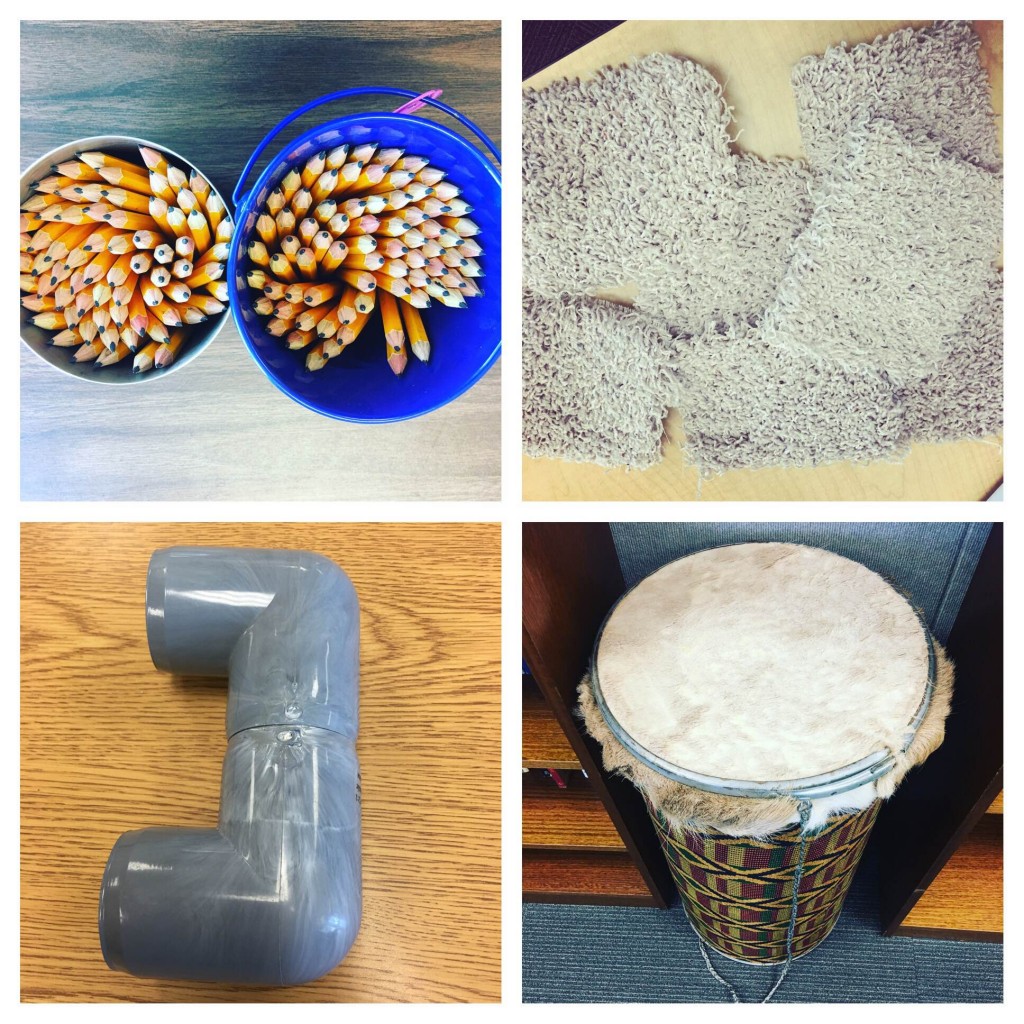
Often it’s the little things that make life in our classrooms easier.
GOLF PENCILS. One of the biggest roadblocks to getting down to business is the old “I don’t have a writing utensil” problem. Instead of getting all uptight and letting it derail a portion of a class period, I keep lots of golf pencils on hand. It removes the hassle. “I need a pencil” + “Okay here” is a lot less stressful than “Goll dangit kid! Can’t you just be responsible? I guess you’ll have to go to your locker or borrow from a friend or give me your shoe so I get it back!” (Who really wants a high school student’s shoe? I mean … really.)
CARPET SQUARES. I listen to lectures better when I am a doodling. Some people like to have something in their hands to play with to help them focus. Other people are tappers. While doodling and fidgeting are usually not distracting to others, tapping can be, so I keep carpet squares on hand. The students can drum them with their hands or a pen or pencil and it pretty much muffles the sound altogether. My tappers and the people around them can all be happy at once.
WHISPER PHONES. Reading aloud is helpful to some students. It’s one more kinesthetic layer to their learning. Obviously, if you have a room full of students trying to read, some prefer quiet though. Reading aloud isn’t quiet, unless you whisper into a whisper phone (which can easily be made with two PVC elbows). You hold it like a phone and whisper it into one end and the sound travels to your ear through the “C” without broadcasting to the room. I can have a room full of silent readers with a handful of students quietly reading to themselves out loud. This works well too for students who are checking their own writing for errors in a quiet room and need to listen for errors (because we often catch errors with our ears that our eyeballs miss).
DRUM. Reading your own writing aloud in front of peers is for some reason less scary when you have a drum accompaniment. Weird, but true. Also, if you teach English, the drum is vital for any reading of “The Telltale Heart.”
None of these ideas are mine. I’ve learned of them from other educators over the years, and like a chef using someone else’s recipe, I’ve tweaked them to make them work in my classroom.

Mysticsartdesign / Pixabay
We are finishing out the year with To Kill a Mockingbird. One of the test questions asks the students to identify the three most important events/issues in the book (which is FULL of important events and issues) and justify why they are the MOST important of all. One of the reasons I love this book is that I learn something new every time I read it and by reading the students’ responses, I am learning new things again, after reading this story again for the (literal) twentieth time. Students are so insightful and can zero in on the smallest scene that I’ve been glazing over for years and give it new meaning. One of the biggest takeaways from this book (no matter how many times I read it) is that people get caught up in looking at things their way and forget that everyone brings a unique set of experiences that shape the way they see the world and subsequently affect the way they behave. It’s the human way. Sometimes, we have to make a conscious effort to be empathetic to others. Atticus says, “You never really understand a person until you consider things from his point of view … Until you climb inside of his skin and walk around in it.” Teaching allows me to see things from these brilliant young people’s points of view. What a unique career perk. This is just one of many reasons why I am happy to be a teacher.
NOTE from July 29, 2021: I no longer love TKAM the way I used to. I struggle with the white savior complex that this book presents. I advocated for a switch to The Hate U Give in my previous school, but the proposal was declined because THUG wasn’t “rigorous” enough according to the powers that be. I no longer HAVE to teach TKAM, but if I ever HAD to again, I would definitely approach it with a critical lens.